For years, the professional cleaning industry has relied on harsh chemicals to tackle tough dirt and eliminate odours. The approach was one of brute force. using high-alkalinity or high-acidity products to dissolve grime. While effective to a degree, this method often creates hazardous conditions, damages surfaces, and leaves behind strong chemical smells. Today, a more intelligent and sustainable technology is changing the game: bio-enzymatic cleaners.
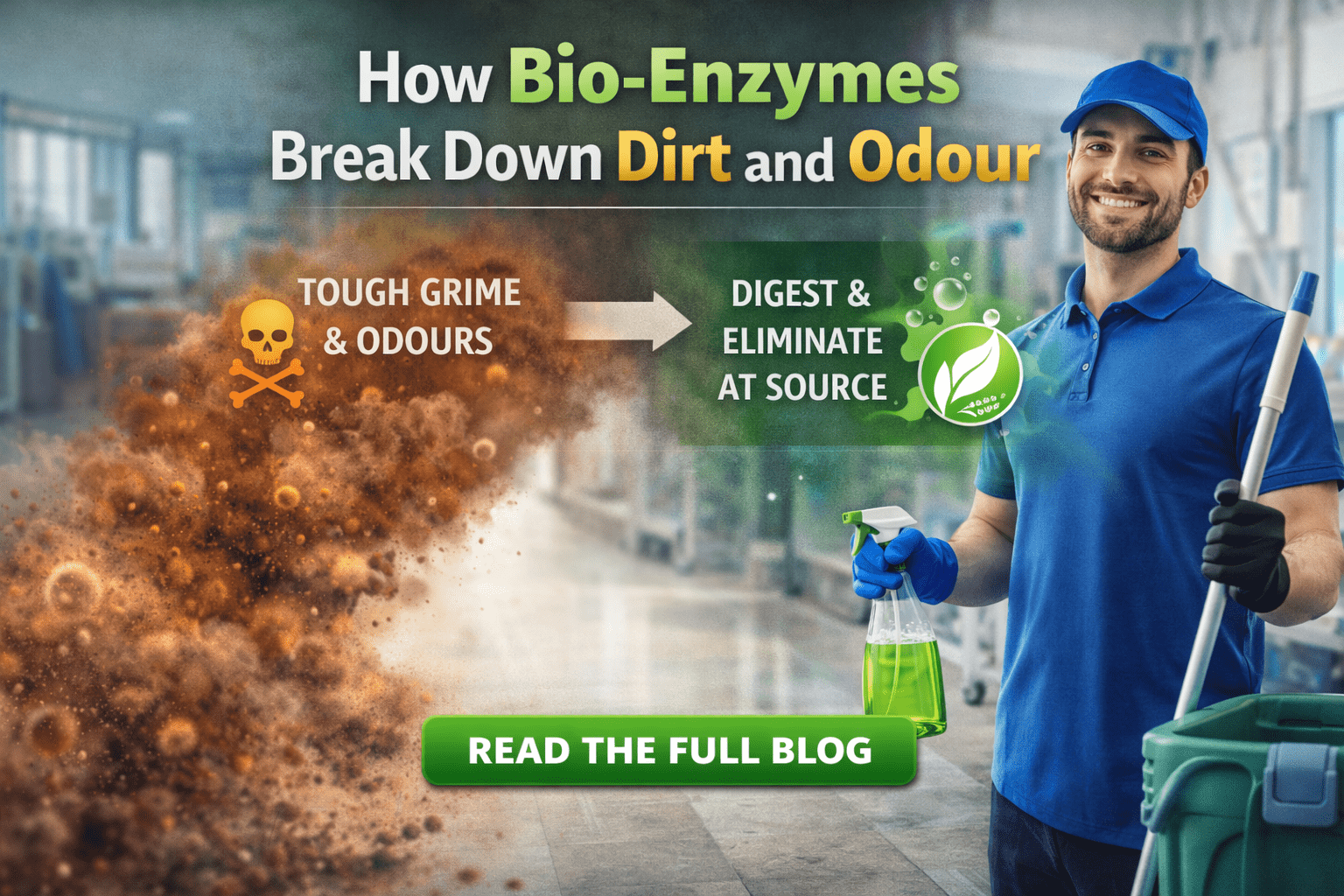
Bio-enzymes work with nature, not against it. In simple terms, these specialized proteins act as biological catalysts to break down complex organic waste into simple, harmless substances. Instead of just masking odours or pushing dirt around, they digest the source of the problem. For facility managers and distributors, this represents a powerful shift toward solutions that deliver a deeper, longer-lasting clean while being fundamentally safer for people, property, and the planet.
Table of Contents
Rethinking Chemical Inventories with Bio-Enzymatic Science
A typical janitorial closet is filled with a variety of specialized chemicals: a caustic drain opener, an acidic toilet bowl cleaner, a separate carpet spotter, and a general-purpose sanitizer. This complexity increases purchasing costs, complicates staff training, and raises the risk of dangerous chemical handling errors.
Bio-enzymatic cleaners offer a path to radical simplification. Because enzymes are highly specialized, a single green cleaning solution can be formulated with a blend of enzymes to tackle multiple problems. For example, a single bio-enzymatic floor cleaner can contain protease to break down food soils, lipase to digest grease, and amylase to tackle starches. This multi-pronged action allows one product to replace several conventional ones. For distributors and facility managers, this means a smaller, safer, and more efficient chemical inventory.
Preserving Facility Assets with Targeted Cleaning Action
Harsh chemicals cause significant wear and tear on facility assets. Corrosive drain openers can damage pipes over time. High-pH degreasers can strip the finish from floors, requiring costly refinishing. Acidic cleaners can etch into grout, creating pores where new bacteria can grow. This chemical assault shortens the lifespan of valuable infrastructure.
Bio-enzymatic facility care products work with surgical precision. Enzymes are substrate-specific, meaning they only act on their target molecule. lipase only breaks down fats, protease only breaks down proteins, and so on. They are completely inert to inorganic surfaces like metal pipes, floor finishes, and ceramic tile. This allows them to digest the grime without harming the underlying material. By using bio-enzymes, facilities can protect their investments and reduce the significant costs associated with chemical-induced damage.
Eliminating Odours, Not Just Masking Them
Persistent bad odours in restrooms, kitchens, and waste areas are a common and difficult challenge. Traditional air fresheners only mask these smells with perfumes, a temporary solution that fails once the fragrance wears off. The odour-causing bacteria, feeding on organic waste, remain and continue to produce foul smells.
Bio-enzymatic eco-friendly cleaning solutions provide a permanent solution by eliminating the source. The enzymes in these products break down the organic matter. urine, grease, food particles. that odour-causing bacteria feed on. Once their food source is gone, the bacteria cannot survive, and the odour is eliminated for good. The beneficial bacteria included in these formulas continue to work long after application, providing residual cleaning and odour control that chemical cleaners simply cannot match.
The Compelling ROI of Bio-Enzymatic Solutions
The switch to bio-enzymatic cleaners is not just an environmental decision; it is a financially sound one. Facility managers and distributors who analyze the total cost of ownership find a strong Return on Investment (ROI).
Reduced Labour Costs
Bio-enzymatic cleaners continue working long after the initial cleaning is done. This “residual cleaning” action means that surfaces stay cleaner for longer, reducing the frequency and intensity of future cleaning tasks. This is particularly effective in maintaining drain lines and grease traps.
Lower Water and Energy Usage
Many bio-enzymatic cleaners are designed to be highly effective in cold water, reducing the energy costs associated with hot-water cleaning. Their powerful action also often requires less water for rinsing compared to high-foaming chemical cleaners.
Enhanced Safety and Compliance
Because they are non-toxic, non-corrosive, and non-flammable, bio-enzymatic cleaners create a safer environment for staff. This reduces the risk of workplace injuries, chemical burns, and respiratory issues, leading to fewer workers’ compensation claims and a more productive workforce.
Future-Proofing Hygiene with Living Technology
As regulations around chemical safety and wastewater discharge become more stringent, companies relying on harsh traditional chemicals will face increasing compliance challenges. The market is also shifting, with clients and customers demanding greater transparency and a commitment to sustainability.
Integrating bio-enzymatic cleaners into a sustainable cleaning strategy is a forward-thinking move. These products are inherently biodegradable and environmentally responsible. Adopting them positions a facility or distribution business as a leader in green innovation. It ensures compliance with future environmental standards and aligns the brand with the growing demand for safe, sustainable, and effective hygiene solutions.
About Sanirite
At Sanirite, we redefine hygiene through eco-innovation. We deliver powerful, bio-based cleaning solutions powered by green chemistry to protect people, spaces, and the planet. We are your trusted partner in creating safer, more sustainable environments.
Conclusion
Bio-enzymes represent the next evolution in professional cleaning. By harnessing the power of nature, these advanced cleaners break down dirt and eliminate odours at their source, providing a level of clean that traditional chemicals cannot achieve. For distributors and facility managers, they offer a safer, more efficient, and cost-effective way to maintain pristine environments, protect valuable assets, and build a truly sustainable operation.
Frequently Asked Questions (FAQ)
How do bio-enzymes work?
Bio-enzymes are specialized proteins that act as catalysts. They lock onto specific types of organic soil (like grease or protein) and break the large molecules down into smaller, water-soluble ones that can be easily washed away.
Are bio-enzymatic cleaners disinfectants?
No, not on their own. Enzymes break down soil but do not kill microorganisms. However, by removing the biofilm and food source that pathogens hide in and feed on, they make surfaces easier to disinfect and prevent the regrowth of bacteria.
What types of enzymes are used in cleaners?
The most common types are protease (breaks down proteins), lipase (breaks down fats and grease), amylase (breaks down starches), and cellulase (breaks down cellulose, found in paper and plant-based soils).
Are these products safe to use?
Yes. Bio-enzymatic cleaners are non-toxic, non-corrosive, and pH-neutral, making them exceptionally safe for users and a wide variety of surfaces. They are a significant safety upgrade from harsh caustic or acidic cleaners.
How long do enzymes continue to work after application?
The beneficial bacteria in bio-enzymatic cleaners can remain active for hours or even days as long as a food source (dirt) and moisture are present. This provides continuous cleaning action, especially in drains, grout lines, and fabrics.
Tags: how bio-enzymes work, enzymatic cleaners, bio-enzymatic cleaners, odour elimination, green cleaning technology, lipase protease, sustainable cleaning solutions