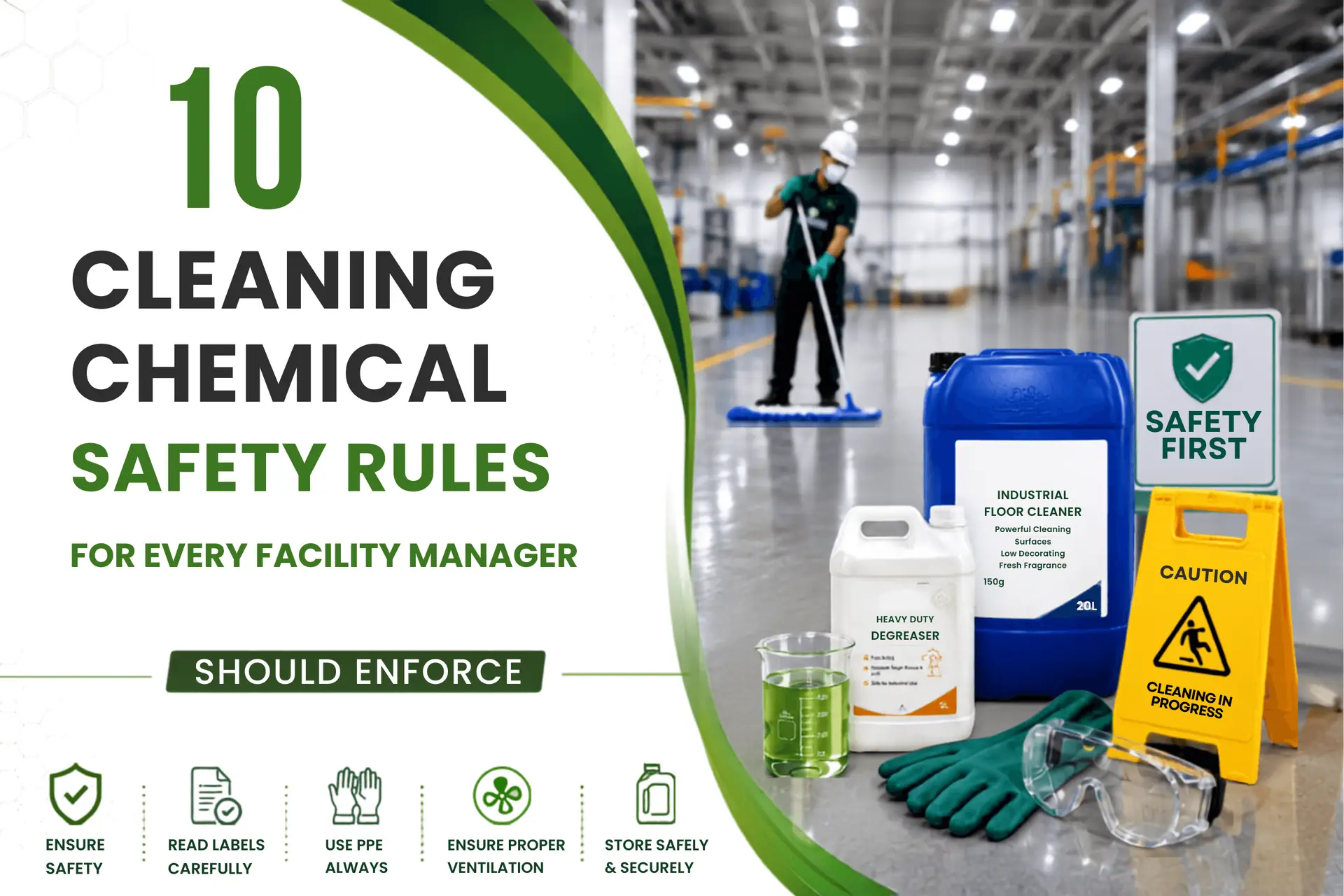

10 Cleaning Chemical Safety Rules for Facility Managers
A housekeeping supervisor at a Pune manufacturing unit once mixed a leftover toilet cleaner with a floor descaler to “finish the bottle faster.” Within seconds, the washroom filled with a sharp gas that sent three staff members to the hospital. Nothing was stolen, no equipment broke just one small, avoidable decision.
This happens more often than facility managers like to admit. Cleaning chemicals are treated as “just cleaning stuff” until someone gets hurt, a surface gets ruined, or an inspector asks for a Safety Data Sheet nobody can find.
If you manage a facility, an office, a hotel, a hospital, a factory floor, or a commercial kitchen the chemicals your housekeeping team uses every single day carry real risk when handled carelessly. The good news: almost every chemical-related incident is preventable with a handful of consistently enforced rules.
Here are 10 cleaning chemical safety rules every facility manager in India should build into their cleaning operations.
Table of Contents
Table of Contents
- Why This Isn’t Just a “Housekeeping Problem”
- Rule 1: Nobody Uses a Chemical Without Reading the Label First
- Rule 2: Keep the Safety Data Sheet Where Staff Can Actually Find It
- Rule 3: Never Let Staff Mix Two Products “To Clean Faster”
- Rule 4: Dilution Is Not a Guessing Game
- Rule 5: Match PPE to the Chemical, Not to Habit
- Rule 6: Don’t Clean in a Sealed Room
- Rule 7: Store Chemicals Like You’d Store Anything Dangerous Because It Is
- Rule 8: Train Every New Hire Before Their First Bottle, Not After Their First Mistake
- Rule 9: Have a Spill Plan Before You Need One
- Rule 10: Buy the Right Chemical for the Job, Not the Cheapest One
- How Safety Rules Change by Facility Type
- A Quick Self-Audit: Is Your Facility Actually Following These Rules?
- FAQ’s
Why This Isn’t Just a “Housekeeping Problem”
Most facility managers assign chemical safety to housekeeping and move on. But when something goes wrong, it’s rarely just a housekeeping issue; it becomes a compliance issue, an insurance claim, a client complaint, or in hospitality and healthcare settings, a reputational crisis.
The risk isn’t only concentrated acids or industrial degreasers. Even a routine glass cleaner or toilet descaler can cause skin irritation, breathing difficulty, or eye injury when the basics are skipped. The chemicals aren’t the problem the shortcuts are.
Rule 1: Nobody Uses a Chemical Without Reading the Label First
It sounds obvious, but in most facilities, experienced staff stop reading labels after the first few uses and they “know” the bottle by color or smell. That’s exactly how mistakes happen when a supplier changes packaging or a new SKU enters the storeroom.
Every label should be checked for:
- What the product is actually meant to clean
- Dilution ratio
- Required PPE
- Storage instructions
- First-aid steps if something goes wrong
If a label is torn, faded, or the bottle has been transferred without a label, it goes unused until it’s identified with no exceptions.
Rule 2: Keep the Safety Data Sheet Where Staff Can Actually Find It
A Safety Data Sheet (SDS) is the detailed technical profile of a chemical, how it behaves, what to do if it spills, what happens on skin contact, and how to store it safely.
Here’s the gap in most Indian facilities: the SDS exists, but it’s sitting in a manager’s email inbox, not near the chemical itself. During an actual spill or exposure, nobody has time to search for a PDF.
Keep printed or laminated SDS copies at the point of use in the housekeeping store, not just the admin office.
Rule 3: Never Let Staff Mix Two Products “To Clean Faster”
This is the single most dangerous habit in facility cleaning, and it’s usually well-intentioned if someone thinks combining two cleaners will work harder on a stubborn stain.
Certain combinations release toxic gas. The classic example: mixing a bleach-based product with an ammonia or acid-based one. But the safer rule to teach your team isn’t a chemistry lesson it’s simpler:
“If the label doesn’t say it can be mixed, it doesn’t get mixed. Ever.”
If a surface needs stronger cleaning power, that’s a signal to pick a different product not to combine two.
Rule 4: Dilution Is Not a Guessing Game
Concentrated cleaning chemicals are designed to be diluted at a specific ratio. Skipping proper measurement in either direction causes real problems:
- Too weak → the surface doesn’t actually get clean or disinfected, defeating the purpose entirely
- Too strong → higher chemical cost, surface damage, chemical residue, and greater exposure risk for your own staff
“Eyeballing it” is one of the most common and most expensive habits in Indian facility cleaning. A simple dosing pump, marked measuring cup, or pre-diluted product removes the guesswork entirely.
Rule 5: Match PPE to the Chemical, Not to Habit
Not every cleaning task needs the same protective gear, and that’s exactly why PPE gets ignored and staff assume “gloves are gloves.”
A worker using a mild diluted glass cleaner has a very different exposure risk than one handling a concentrated acidic descaler or an industrial degreaser. PPE should be decided by the product label and task, which may include:
- Chemical-resistant gloves
- Safety goggles or face shields
- Aprons or protective clothing
- Closed footwear
- Respiratory protection for specific high-fume products
If your team treats PPE as optional “when it’s hot” or “when there’s no supervisor around,” that’s a training gap, not a discipline problem.
Rule 6: Don’t Clean in a Sealed Room
Vapours and fumes build up fast in enclosed spaces; small washrooms, storage rooms, basements, and closed kitchens are the most common trouble spots.
A strong chemical smell isn’t a sign the product is “working better” it’s often a warning sign that airflow is inadequate. Keep ventilation points open during and after chemical use, and if any staff member reports dizziness, headache, or breathing discomfort, the task stops immediately.
Rule 7: Store Chemicals Like You’d Store Anything Dangerous Because It Is
Storage failures are where a lot of Indian facilities quietly fail audits. Common issues:
- Chemicals decanted into unlabeled bottles “for convenience”
- Incompatible products stored next to each other
- Chemicals stored near food, drinking water, or in direct sunlight
- Damaged containers left in use
Every chemical should stay in its original, labeled container, in a dry and organised space, separated according to the manufacturer’s compatibility guidance, and kept away from food-contact and drinking-water zones.
Rule 8: Train Every New Hire Before Their First Bottle, Not After Their First Mistake
Most facilities train new housekeeping staff by pairing them with an experienced colleague which means bad habits get passed down along with the good ones.
A proper chemical safety induction should cover label reading, dilution, PPE, storage, and what to do during a spill before a new hire touches a single chemical unsupervised. Refresher training matters just as much, especially when a new product is introduced or a near-miss happens.
Rule 9: Have a Spill Plan Before You Need One
When a chemical spills, the first 60 seconds matter. Staff shouldn’t be improvising in that moment they should already know:
- What the product is
- Where its SDS is kept
- What PPE the response needs
- Whether the area needs to be cordoned off
- What material is safe to use for containment
- How the waste gets disposed of
- When to escalate to a supervisor or emergency services
The worst spill response is grabbing a different chemical to “clean up” the first one. Never combine chemicals during a cleanup treat the spill and the original safety rules the same way.
Rule 10: Buy the Right Chemical for the Job, Not the Cheapest One
Chemical safety starts at the purchasing decision, not the cleaning cart. A cheap multi-purpose cleaner that claims to “do everything” is often a false economy it either underperforms on tough jobs (leading staff to over-apply it) or is too harsh for delicate surfaces.
Match the product to the actual problem:
- Grease and oil buildup → A dedicated degreaser suited to the surface
- Washroom scale and soap residue → A descaler formulated for that specific deposit
- Glass and mirrors → A streak-free glass-safe formula
- Floors → Chosen by floor material, not a generic “floor cleaner” label
- Food-contact areas → Products that meet food-safety handling requirements
How Safety Rules Change by Facility Type
Manufacturing plants deal with heavier-duty degreasers and metal cleaners, often used during maintenance shutdowns this is where concentrated-chemical exposure risk is highest.
Food processing units need chemical safety layered with hygiene compliance storage away from food zones and clear documentation for audits (FSSAI and internal QA teams will ask).
Hospitals and clinics need staff to clearly understand the difference between routine cleaning and disinfection, and follow infection-control protocols specific to the area (OT vs. general ward vs. corridor).
Corporate offices have high foot traffic near cleaning activity, making ventilation, timing, and signage as important as the chemical itself.
Hotels run the widest variety of chemicals across guest rooms, kitchens, washrooms and public areas which is exactly why storage discipline and staff training matter most here.
Check our related Article:
1. how to remove metal rust safely for more on handling metal cleaners and rust on equipment.
2. green chemicals for the food industry for more on hygiene-compliant cleaning products.
A Quick Self-Audit: Is Your Facility Actually Following These Rules?
Ask yourself honestly:
- Can your housekeeping supervisor find the SDS for your top 3 chemicals in under a minute?
- Has every current staff member been trained on dilution or did they just “pick it up”?
- Are any chemicals sitting in unlabeled bottles right now?
- Does your team know your facility’s spill response, or would they improvise?
- When did you last review your chemical storage area?
If two or more of these gave you pause, it’s worth a proper walkthrough this week not next quarter.
Contact SaniRite today to get the right cleaning products for your facility, along with dilution guidance, product training, and bulk pricing.
📞 +91 92265 79145 📧 Sales: smm@sanirite.in
Join thousands of hotels, restaurants, and food businesses across India choosing safer, greener cleaning.  Follow SaniRite for insights that protect your people and your business.
Frequently Asked Questions (FAQ)
Is it okay to mix two mild cleaning chemicals if neither is labeled hazardous?
No. “Mild” on a label doesn’t guarantee a safe reaction when combined with another product. Unless the manufacturer explicitly confirms two products are compatible, they should never be mixed. This applies even to products marketed as eco-friendly or non-toxic.
Do eco-friendly or green cleaning chemicals still need PPE?
Yes. “Eco-friendly” refers to environmental impact, not zero handling risk. Many green-certified products still require gloves or eye protection depending on concentration and application. Always check the label, not the marketing claim.
How often should chemical safety training be repeated?
At minimum, every new hire needs training before independent use, and a refresher whenever a new product is introduced, a process changes, or a near-miss occurs. Many facilities also run an annual refresher regardless.
What's the single most common chemical safety mistake in Indian facilities?
Incorrect dilution and unlabeled decanted bottles both come from convenience habits rather than a lack of awareness, which is why enforcement (not just training) matters.
Who is responsible for chemical safety housekeeping staff or facility management?
Both, but the accountability sits with facility management. Housekeeping staff can only follow procedures that are clearly defined, trained, and enforced; the system has to be built by the people managing the facility.