
GMP Cleaning Checklist for Manufacturing Units: Daily, Weekly and Monthly
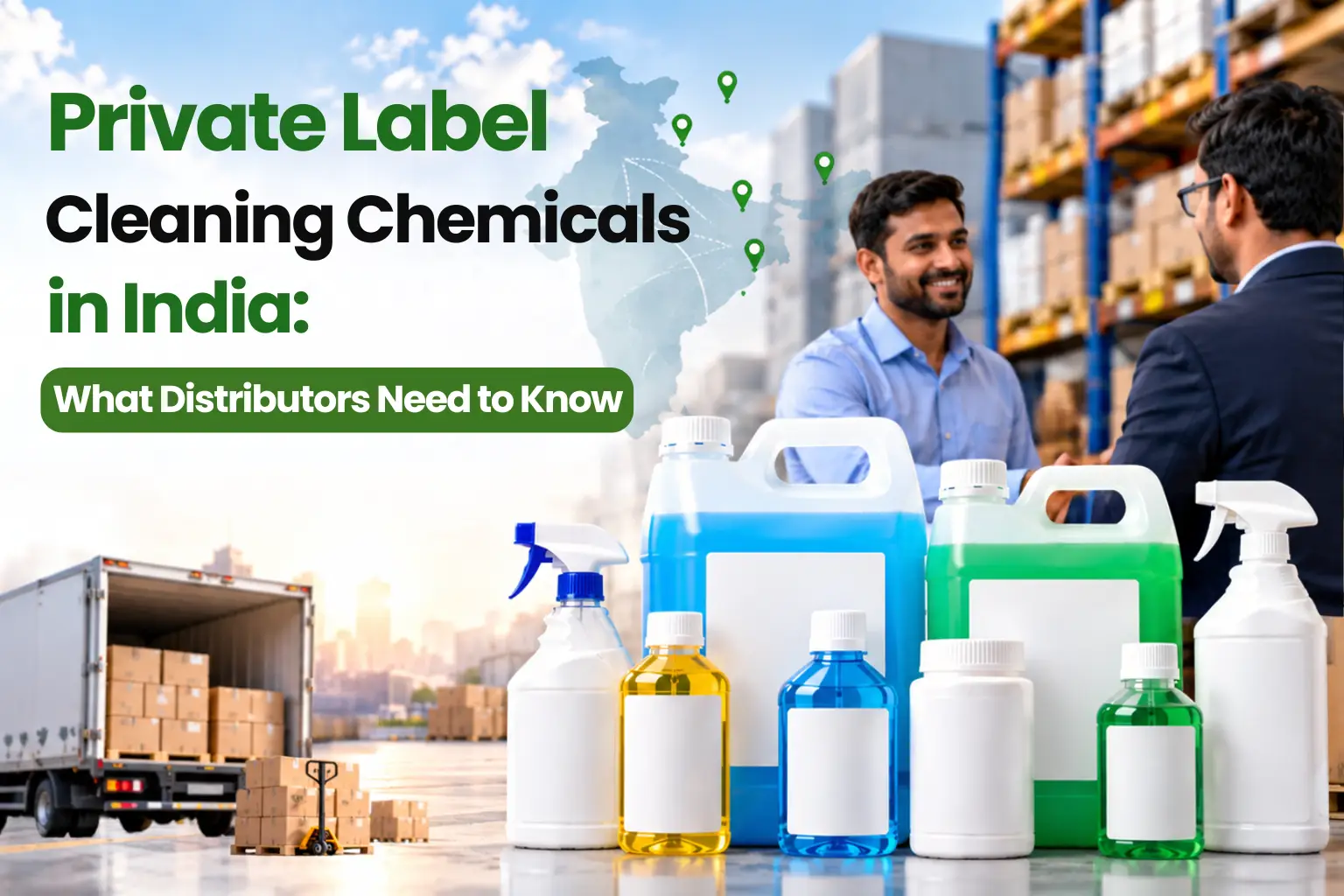
Every distributor who has spent years reselling someone else’s cleaning chemical brand eventually asks the same question. Why am I building someone else’s business instead of my own? Private label manufacturing is how distributors, wholesalers, and institutional suppliers across India are answering that question, turning a reseller margin into a brand they actually own. But before signing with a manufacturer, there’s a lot that first-time buyers wish they’d known earlier.
This guide explains how the process actually works, what it costs, what compliance to insist on, and how to avoid the mistakes that cost new distributors money on their first order.
Table of Contents
What Is Private Label Cleaning Chemical Manufacturing?
Private label manufacturing means a formulator produces cleaning chemicals, such as floor cleaners, degreasers, and multi-surface cleaners, which you then sell under your own brand name, packaging, and pricing. This differs from white labelling, where you typically select an existing formula with little or no customisation. With private label, you have more control over the formulation, fragrance, concentration, and how you position the product in the market.
This is sometimes also referred to as third party manufacturing or contract manufacturing, since you are contracting an existing manufacturer to produce under your brand rather than operating your own facility.
For a distributor, this distinction matters because it determines how much you can differentiate from competitors selling the same generic products under different names.
Why Distributors in India Are Choosing Private Label
Distributors who already resell third-party brands often reach a ceiling. Margins are fixed by the brand’s pricing structure, customer loyalty belongs to the brand rather than the distributor, and there is little room to build a distinct market position.
Private label cleaning chemicals in India solve this in three ways.
First, you build brand equity that belongs entirely to you rather than to the manufacturer whose name is on the bottle.
Second, you set your own margin instead of working within someone else’s minimum retail price.
Third, you can build direct, repeat relationships with institutional buyers such as hotels, hospitals, and corporate facilities under your own name, which compounds in value over time as your brand becomes known in that specific buyer segment.
This is also why demand for private label options has grown steadily among mid-sized distributors who want to scale beyond pure resale. For broader context on how manufacturing units across India are approaching cleaning chemical sourcing, see our related read on: cleaning chemicals for Indian manufacturing units.
How the Private Label Process Works
Most manufacturers in India follow a broadly similar sequence, even though timelines and flexibility vary.
Formulation discussion
You share what you need, whether that is a specific fragrance, a concentration level, a green certification requirement, or a particular use case such as facility housekeeping, hotel operations, or corporate office cleaning.
Sample approval
The manufacturer produces a small batch for you to test. This stage is where quality issues should be caught early, before any bulk commitment.
Minimum batch production
Once you approve the sample, the manufacturer produces at the agreed minimum order quantity.
Packaging and label finalisation
Your branding, label design, and bottle or container format are locked in during or before this stage.
Dispatch and delivery
The finished, branded product is packed and shipped to you.
Understanding this sequence matters because it helps you set realistic expectations with any manufacturer you are evaluating, and it gives you a clear checklist to hold them accountable to at each stage.
Minimum Order Quantity Explained
Minimum order quantity, or MOQ, is often the first filter that rules manufacturers in or out for smaller distributors. A manufacturer with a very high MOQ may be unrealistic for a distributor just starting to test a private label line, while a very low MOQ manufacturer might signal limited production capacity or higher per-unit costs.
Ask every manufacturer you evaluate for their MOQ per product category, since a single company may have different minimums for a glass cleaner versus a bulk floor cleaner concentrate. If you are still deciding whether private label is right for your business, starting with a manufacturer offering a lower MOQ can reduce your initial risk considerably.
SaniRite’s exact MOQ and lead time vary by product category and are confirmed directly with each enquiry.
Cost Factors to Budget For
Costs for private label cleaning chemicals vary based on several factors, and there is rarely a single flat number a manufacturer can quote without more detail from you.
Formulation complexity affects cost directly. A simple all-purpose cleaner is generally less expensive to produce than a specialised industrial degreaser or a heavy-duty stain remover requiring specific active ingredients.
Packaging format also plays a large role. Bottles, drums, cans, and pouches all carry different unit costs, and custom moulded packaging will cost more than standard stock bottles.
Order volume affects your per-unit price, with larger orders generally leading to lower costs, however, you will need to balance this with your ability to sell through that quantity.
Custom fragrance, colour, or additional certifications such as eco labels can also add to the base cost.
Rather than expecting a single quoted number, request itemised quotes from two or three manufacturers so you can compare formulation cost, packaging cost, and any setup or tooling fees separately. This makes it much easier to identify where you’re paying a premium and whether it’s justified.
Certifications and Compliance to Verify
Before finalising any manufacturer, confirm they can provide GST registration, GMP compliance, and full safety data sheet documentation, often referred to as SDS or GHS documentation, for every formulation you plan to sell.
This is not optional if you intend to sell to institutional buyers. Hospitals, hotels, and corporate facilities routinely require compliance paperwork before they will even consider procurement, and being unable to provide an SDS on request can disqualify you from a deal, no matter how good your product is.
In India, safety data sheet requirements are set out under the Manufacture, Storage and Import of Hazardous Chemical Rules, 1989, administered by the Ministry of Environment, Forest and Climate Change. India has not formally adopted the international GHS format, so a compliant SDS in India can follow either the Rule’s own required sections or a GHS-style format, which most manufacturers now use since it is also accepted internationally.
It is reasonable to ask a prospective manufacturer directly whether they provide SDS documentation as a standard part of their private label package. For a broader look at chemical handling safety, see our post on 10 cleaning chemical safety rules.
What Must Legally Appear on Your Label
Under Rule 6 of the Legal Metrology (Packaged Commodities) Rules, 2011, every pre-packaged product sold in India, including a privately labelled cleaning chemical, must carry specific declarations. These include the name and address of the manufacturer, packer, or importer, the generic name of the commodity, the net quantity in standard units, the month and year of manufacture or packing, the maximum retail price inclusive of all taxes, and a contact for consumer complaints, including phone number and email.
When you private label, your brand typically appears on the pack as the packer or marketer rather than the manufacturer. Confirm with your manufacturer in advance exactly whose name and address will appear in each required field, since this affects who is legally responsible if the rules are not followed correctly.
Packaging and Branding Customisation
Label design, bottle or container sizing, and packaging materials all affect both cost and how buyers perceive your brand. Eco-friendly packaging options, such as recyclable HDPE bottles or refill pouches, are increasingly expected by institutional buyers with their own sustainability commitments.
Finalise your packaging decisions early in the process. Changing bottle size or label format midway through production usually means added cost and delay, since moulds, printing plates, or packaging stock may already be committed.
Why Eco-Friendly, Bio-Based Formulations Matter
Institutional buyers increasingly ask for green-certified formulations rather than simply effective cleaners. This shift is being driven by corporate sustainability targets, hospital procurement standards, and growing awareness among facility managers of the health and environmental impact of harsh chemical cleaners.
SaniRite’s own range, including the OxyShield series and the ExPertico series, is built on bio-based, GreenPro certified formulations. GreenPro is an ecolabel administered by the Confederation of Indian Industry, and is worth knowing about if certification credibility is part of what you are evaluating in a manufacturing partner, since not every manufacturer offering private label services can back their eco claims with third-party certification.
How to Choose the Right Manufacturer
A few criteria consistently separate a reliable private label manufacturer from a risky one.
Look for verifiable certifications, including ISO 9001:2015, GMP, and relevant eco certifications such as GreenPro, rather than taking claims at face value.
Ask for transparent MOQ and pricing structures upfront, rather than vague estimates that shift once you are further into the process.
Check sample turnaround speed, since a manufacturer who takes weeks to produce a single test sample may not be realistic for your timeline once you scale to full orders.
Most importantly, confirm whether they will actually hand you documentation such as SDS and compliance certificates without you having to repeatedly follow up. This single factor often reveals more about how a manufacturer will treat you as an ongoing partner than any sales conversation will.
It is also worth raising exclusivity and formula ownership directly with any manufacturer before signing. Will they sell the same formulation to a competitor in your city? Who owns the formulation if you later part ways? These are commercial terms that vary by manufacturer, so get them confirmed in writing before you commit. SaniRite can walk you through its position on both when you reach out.
Common Mistakes to Avoid
New distributors entering private label manufacturing tend to repeat a small set of avoidable mistakes.
Skipping sample testing before committing to a bulk order is the most common and costly. A sample that looks acceptable on paper can still perform poorly in real use, and catching that after a full production run is far more expensive than catching it before.
Not confirming SDS and compliance documentation availability upfront is another frequent issue, often surfacing only when an institutional buyer asks for paperwork you cannot provide.
Underestimating packaging lead time is a third common mistake, particularly when custom bottle moulds or printed labels are involved.
Finally, choosing a manufacturer based solely on the lowest MOQ or price, without properly evaluating formulation quality and certification, often creates problems that cost more to fix later than the initial savings were worth.
How Can SaniRite Help
SaniRite operates under Richards Chemicals & Electricals Pvt. Ltd., established in 1998, and holds GreenPro, ISO 9001:2015, and GMP certifications. For distributors evaluating a private label partner against the criteria covered in this guide, SaniRite provides documented certifications on request, bio-based formulations across ranges such as OxyShield, ExPertico, SuperNova, and FodOx, and support through formulation, sampling, and packaging customisation.
A private label conversation with us covers bulk order options, minimum order quantities, exclusivity, formula ownership, payment terms, shelf life, and documentation.
Frequently Asked Questions (FAQ)
What is private label cleaning chemical manufacturing?
Private label manufacturing is when a formulator produces cleaning chemicals that you sell under your own brand name and packaging, rather than reselling an existing brand.
What is the minimum order quantity for private label cleaning chemicals in India?
Minimum order quantity varies by manufacturer and product type. It is best to confirm this directly with each manufacturer before budgeting, since it can differ significantly between product categories. For SaniRite MOQ and lead times, use the enquiry button above or contact us directly.
How much does private label cleaning chemical manufacturing cost in India?
Cost depends on formulation complexity, packaging format, order volume, and any custom fragrance or certification requirements. Getting itemised quotes from multiple manufacturers is the most reliable way to estimate cost accurately.
How long does the private label manufacturing process take?
The process typically takes several weeks from initial sample approval to final dispatch, though this depends on formulation complexity and the level of packaging customisation.
Do private label cleaning chemical manufacturers provide SDS documentation?
Not all manufacturers provide this automatically. Confirm SDS and GHS compliance documentation availability before finalising a manufacturing partner, especially if you plan to sell to institutional buyers.
Is private label cleaning chemical manufacturing profitable for distributors in India?
It can be profitable when margin, minimum order quantity, and compliance costs are properly budgeted against realistic market pricing for the target buyer segment.